
Why You Should Really Kill Off Your Ancestors
How obtaining a copy of a death record for your ancestor can help solve family history mysteries and save you hours of research.

When people first begin researching their family history, there’s a natural temptation to leap backwards as quickly as possible. We race through census returns, parish registers and birth records, eager to see how many generations we can add to our tree.
I completely understand the excitement. After all, discovering that you’ve reached the 1700s, or even earlier, feels like a real achievement.
But in that rush to go further back, one of the most valuable records in genealogy is often overlooked.
Death records.
At first glance they don’t seem particularly exciting. After all, they simply record the end of someone’s life. Compared with a marriage record full of new relatives or a census showing an entire household, they can seem rather underwhelming.
In reality, however, a death record can be genealogical gold.
For those of us who like our family trees to be tidy and complete, a death record closes the final chapter of an ancestor’s story. More importantly, it often opens the door to entirely new discoveries. Addresses, occupations, family members, burial locations and even previously unknown children or spouses can all appear on a single document.
Sometimes the most important clues in your research come at the very end of someone's life.
Death Has Never Been Cheaper
For years, ordering death certificates could become an expensive habit, especially when you were working through several branches of your family.
Thankfully, the UK General Register Office has made life much easier. Digital copies of death entries can now be downloaded instantly for just £3.00, making it far more affordable to fill in the missing pieces of your family tree.
It’s one of the best-value investments you can make in your research.
A Case Study: My Great-Grandfather’s Death Certificate
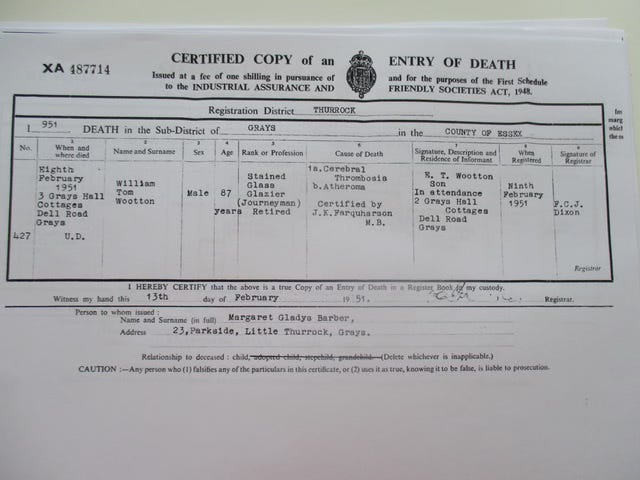
Let’s look at my own great-grandfather’s death certificate and see just how much information one document can reveal.
Date and Place of Death
The certificate gives the exact date of death together with his full address.
That single address immediately provides several new avenues to explore. Electoral registers, property records, street directories and local newspapers may all contain additional information about his final years.
A simple address can unlock an entirely new chapter of someone’s life.
Occupation
His occupation is recorded as “Stained Glass Glazier (Retired).”
I had never previously discovered that he specialised in stained glass rather than simply working as a glazier.
That small detail immediately raises new questions.
Which churches or public buildings might he have worked on? Did he belong to a trade union? Were there newspaper advertisements or business directories mentioning his work? Occupational details like this can transform an ancestor from a name on a page into a real person with skills, experience and pride in their craft.
The Informant
Perhaps the biggest surprise came from the informant.
The death was registered by his daughter, Margaret Gladys Barber, whose address is also recorded on the certificate.
Not only does this confirm an important family relationship, but it also tells me exactly where she was living at the time, giving me another household to investigate.
Even better, I discovered that his son, E. T. Wootton, was living next door. That neatly connected addresses I’d previously seen separately on electoral rolls and helped piece together how the family remained close during his final years.
Would I eventually have found all of this without the certificate?
Possibly.
Would it have taken much longer, with a greater chance of missing something important?
Almost certainly.
That single certificate gave me more genuinely useful information than several hours spent searching online.
Why “Killing Off” Your Ancestors Matters
One of the most important jobs in genealogy isn’t finding new ancestors.
It’s eliminating the wrong ones.
Anyone researching families with common names will know exactly what I mean. In my own tree I have no fewer than nine Thomas Woottons and six William Woottons. Without properly documenting each person’s death, it’s incredibly easy to merge two completely different people into one, or worse, spend months researching the wrong family.
A death certificate allows you to confidently say:
“This Thomas Wootton died in 1938, therefore he cannot be the Thomas Wootton appearing in the 1939 Register.”
As any good detective will tell you, ruling somebody out is often just as valuable as identifying the right person.
Once you’ve confirmed the death, you’ve effectively “killed off” that ancestor, making every future search that little bit easier and preventing costly mistakes.
"One of the most important jobs in genealogy isn't finding new ancestors. It's eliminating the wrong ones."
Finding Burial or Cremation Records
Once you’ve confirmed the death, the next challenge is locating where your ancestor was laid to rest.
Fortunately, you already have several excellent clues.
You know the date of death.
You know the address.
You usually know the registration district.
That gives you a very good starting point.
One of my favourite research tools at this stage isn’t a genealogy website at all, it’s Google Maps.
I simply enter the final address and begin looking for nearby cemeteries, crematoria and churchyards. Quite often you’ll discover several possibilities within walking distance of where your ancestor lived.
Religious background is another useful clue. Church of England, Catholic, Jewish, Methodist and other Nonconformist denominations all tended to favour different burial grounds.
That said, never assume your ancestor remained in the same faith throughout their life.
My own 2× great-grandfather, Thomas Wootton, was baptised into the Church of England. However, after marrying my 2× great-grandmother, Nicolina Elizabeth Stampa, whose family were of Italian descent, he converted to Catholicism shortly before his death.
As a result, they were both buried together in St Mary’s Catholic Cemetery in London.
It’s a perfect reminder that people’s lives often take unexpected turns and so can our research.
Useful Online Resources
Many burial records have now been digitised, making the search much easier than it once was.
Some of my regular starting points include:
Findmypast Burial Index
Find A Grave
Deceased Online
Interment.net
Local authority cemetery databases
Individual cemetery websites, such as Brompton Cemetery
Bear in mind that coverage varies considerably by area, and some services require a subscription or charge a small fee.
Finding the Grave
Locating the cemetery is only half the journey.
Now comes the detective work of finding the actual grave.
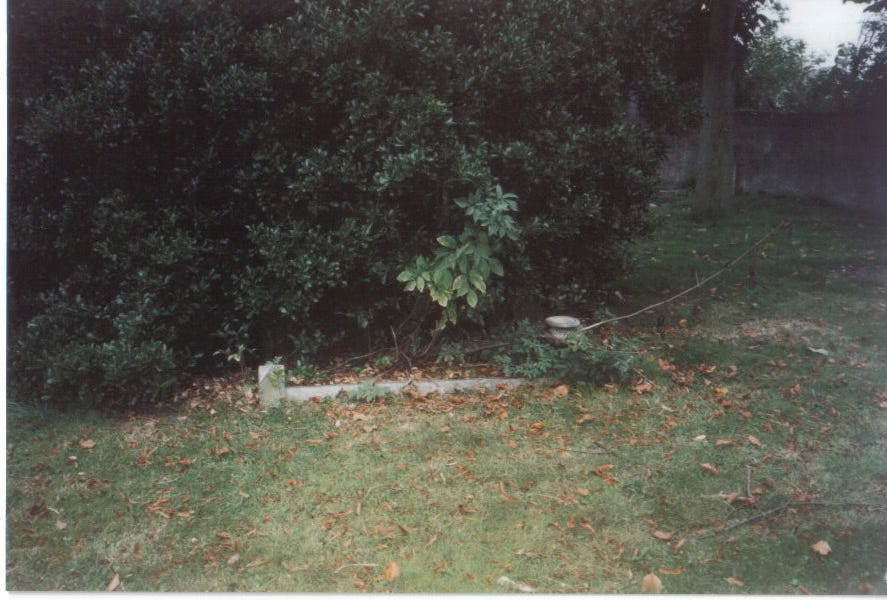
Unfortunately, many ordinary families could not afford permanent memorials. Graves may be unmarked, headstones removed or inscriptions simply weathered away over time.
If possible, contact the cemetery office before your visit. Many hold burial registers and plot maps that aren’t available online.
And here’s my favourite tip of all.
Talk to the gravedigger.
It sounds obvious, but local cemetery staff often possess decades of knowledge that no database can replace. I’ve found several family graves only because someone working there remembered where an old section was or recognised a family name.
Most are incredibly knowledgeable and more than happy to help if they’re not busy.
Once you’ve found the grave, I always recommend recording as much information as possible:
Photograph the grave and any headstone.
Take a wider photograph showing its location within the cemetery.
Record the exact plot number.
Note nearby family graves.
Write down any additional inscriptions that may be difficult to read in photographs.
Your future self will thank you.
One Final Tip
If you’re planning a day exploring churchyards or cemeteries, pack a flask, some lunch and wear comfortable, waterproof clothing.
Family history isn’t always spent sitting behind a computer.
Some of the best discoveries happen outdoors, standing in muddy boots, deciphering a weathered headstone in the rain.
And somehow, those are often the discoveries you’ll remember the most.
By documenting an ancestor’s death and burial, you’re not simply recording how their life ended.
You’re making sure their story is complete.
After all, one day someone may be researching us and hopefully they’ll be grateful that we left them a few good records to find before we became a death certificate ourselves.
🧭 Chiddicks Top Tip
Before you go chasing another generation back, make sure you've properly "killed off" the last one. A £3 digital image today could save you hours of research and could stop you following the wrong Thomas Wootton entirely.
Real records. Real stories. Better family history. 📜
I spend a lot of time researching and sharing these family connections, so if this post helped you uncover part of your family story, you can support my ongoing research here:

If you’d like to follow more of my research and stories, you can explore more here:
Excellent tips. After a recent graveyard tour back home https://substack.com/@gunnarmiller/note/c-287706711 , I'd add one more: Find A Grave photos usully include GPS coördinates in the metadata, which if cut-and-pasted into Google Maps can get you to within 3-10 meters reliably.
If a contributor stood at the stone with a phone, consumer GNSS gives 3–5 m under open sky, degrading to 10–15 m under tree canopy or beside a stone wall or church. Dual-frequency phones (most since ~2018) do better, 1–3 m. If instead they dropped a pin by eye on satellite imagery, the error is whatever they eyeballed plus any errors with Google's imagery georegistration. The pin is placed at your exact coordinate in Google's frame, but the satellite tile underneath has its own registration error, typically 1–5 m in the US, sometimes worse in hilly rural terrain where orthorectification against a coarse elevation model shifts things. So the pin can look off even when the coordinate is perfect.
Still, way better than having to walk a whole graveyard https://gunnarmiller.substack.com/p/were-all-related ... if you do that, you should offer the groundskeeper to push a mower whilst you're at it ;-)
Great article. My mother always said she never really knew where she was born. Her first child was stillborn and the second lived about 18 days. Recently, I located the death certificate of the second child and on it says my mother was born in Huntington, West Virginia. Now, I have a place to start to see if I can find my mother's birth certificate.