

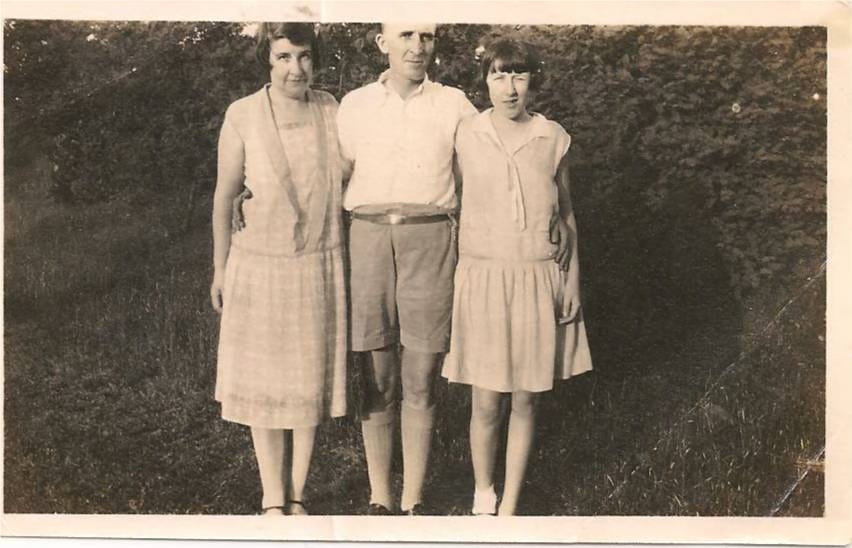
Within four years of Alfred Gregson’s death, the family had left Britain.
First came India.
Then Australia.
Finally, New Zealand.
On paper, the moves made perfect sense. Arthur Gregson was a skilled mill foreman in the woollen industry, part of a generation of British industrial workers whose expertise carried them across the Empire during the early twentieth century.
But family stories are rarely shaped only by practical decisions.
Some journeys begin long before the suitcase is packed.
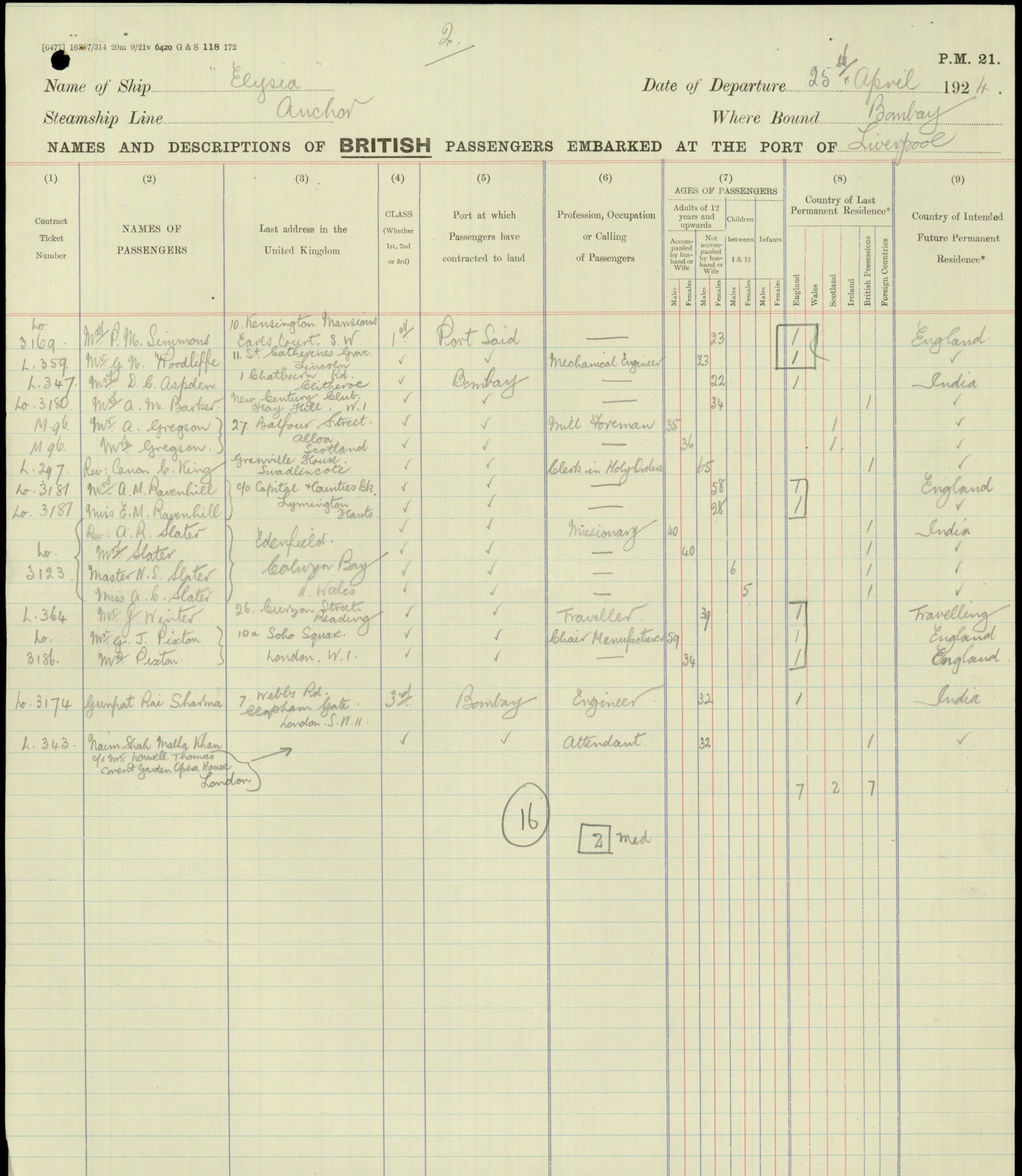
When I first discovered passenger lists carrying Arthur and Frances Gregson from Liverpool to Bombay in 1924, I found myself wondering whether Alfred’s death still lingered in the background of their lives. Whether the memory of Lower House Farm travelled with them across oceans.
Or whether distance itself became a form of escape.
By the time Arthur and Frances boarded the Elysia for India, they had already endured more grief than many families experience in a lifetime.
Arthur had buried his first wife only weeks after Alfred’s birth.
Then he had buried Alfred himself.
The records never say how the tragedy affected the marriage between Arthur and Frances, but it is impossible not to wonder what lingered beneath the surface afterwards. Frances’s own brother had left the loaded shotgun on the wall. Every retelling of Alfred’s death would have led back, eventually, to William Wootton.
No official document records whether the family fractured after the shooting.
But silence leaves traces of its own.
Arthur Gregson
The deeper I researched Arthur Gregson, the more compelling he became.
At first he appeared only as a name in the records: mill foreman, husband, widower, passenger, manager. But gradually a fuller picture began to emerge, a man shaped repeatedly by loss, yet unwilling to stop rebuilding his life.
Arthur had been born in Leicester in 1885 into a family heavily connected to the woollen and worsted trade. Several members of the Gregson family worked in mills across Leicester, and the industry would define much of Arthur’s life. His skills eventually carried him across the world.
Before researching this story, I had never fully appreciated how specialised the woollen industry was. Woollen and worsted production were closely connected but technically distinct trades, requiring different manufacturing processes and expertise. Arthur belonged to a highly skilled industrial world that stretched far beyond the English Midlands.
It was this expertise that likely opened the door to India.
By 1924 Arthur had secured work with Patons Woollen Mills in Bombay. Passenger lists record Arthur and Frances leaving Liverpool together aboard the Elysia, their home address still given as Balfour Street in Alloa, Scotland.
Somewhere between the tragedy at Lower House Farm and the departure for India, the family had chosen movement over permanence.
Perhaps opportunity genuinely was the reason.
But perhaps grief made staying still impossible.
India
The India Arthur Gregson entered in the 1920s was still part of the British Empire, industrial, divided, hierarchical, and deeply shaped by class and caste. Yet family memories of Arthur paint a man who often ignored the social boundaries around him.
While managing workers at the Bombay mill, Arthur reportedly faced a labour shortage and began employing people from groups considered “untouchable” within the rigid caste system of the time.
Some objected.
Arthur’s reported response survived in family testimony for generations:
“Leave your religion at the gate on entry and pick it up again when you leave.”
It is one of the moments where Arthur suddenly feels vividly alive within the surviving records.
Not simply a name on a passenger list or census entry, but a flesh-and-blood human being with opinions, temper, and conviction.
The same stories describe him as loud, commanding, and impossible to ignore. In later years, relatives recalled that his voice could supposedly carry above the roar of factory machinery itself.
There were lighter details too. While in Bombay, Arthur became involved with the Bombay Kennel Club, and family stories claim his dogs won trophies and medals at competitions.
These fragments matter because they complicate the story.
By this point Arthur could easily have become defined entirely by tragedy. But instead the records reveal movement, ambition, and flashes of joy alongside grief.
That complexity is what makes old family stories feel real.
Australia
From India, the Gregsons moved again.
Passenger records place the family travelling onward through Australia during the 1920s before eventually settling for a period in Melbourne. Electoral rolls later show Arthur, Frances, and their daughter Kathleen living in North Melbourne during the 1930s.
Arthur was listed simply as “manager.”
Frances carried out “home duties.”
Kathleen worked as a clerk.
On the surface, the records are ordinary. Quietly domestic. The sort of administrative fragments millions of people leave behind without ever imagining someone might one day piece them together into a story.
Yet even while reconstructing these years through official documents, my thoughts kept returning to Lower House Farm.
Did Arthur and Frances ever speak openly about Alfred after leaving Britain?
Did Frances remain close to her family in Herefordshire?
Did she ever forgive her brother William?
The records remain silent.
Yet the fact that Frances later returned to England from Australia for a visit raises its own questions. Passenger lists from 1934 show Frances and Kathleen travelling from Lower House, Byford, the very place where Alfred had died fourteen years earlier.
By then Frances’s mother had already passed away.
Why return there?
Reconciliation?
Obligation?
Family loyalty?
Or simply because no matter how far people travel, certain places continue to pull at them.
New Zealand
Eventually the Gregsons made what would become their final move, settling in Milton, in New Zealand’s South Island.
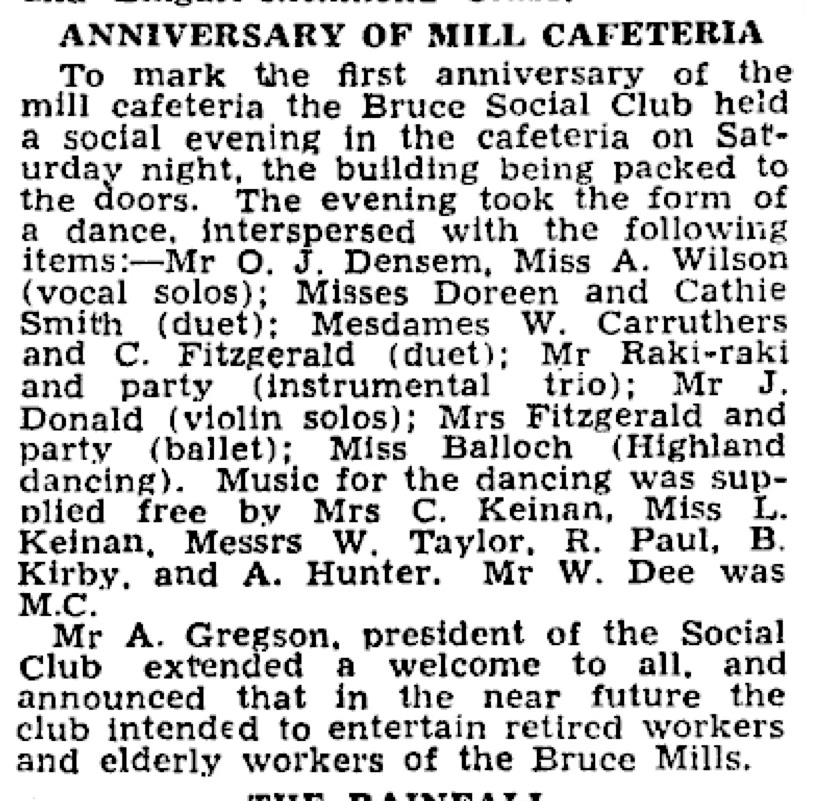
By now Arthur had become an experienced mill manager whose skills were valuable internationally. He likely worked for the Bruce Woollen Manufacturing Company in Otago, where he again built a reputation as a formidable figure inside the mills.
Family stories from New Zealand portray him as both intimidating and progressive.
If something displeased him at work, his booming voice could reportedly be heard above the machinery.
Yet he was also remembered as one of the first white mill managers locally willing to employ Māori women inside the mill itself, at a time when many employers excluded them from industrial work altogether.
The same pattern seemed to follow Arthur throughout his life.
He was conventional in some ways, unconventional in others.
A strict mill manager who ignored social barriers.
A man repeatedly devastated by loss who nevertheless continued building communities wherever he went.
Outside work, Arthur became deeply involved in local life. Newspaper reports from the Otago Daily Times show him participating in church activities, community events, and local organisations. He served as a lay reader in the Anglican church, belonged to the local Masonic lodge, and was remembered as having a powerful singing voice and a love of poetry.
Reading these fragments now, it is difficult not to feel the strange intimacy genealogy sometimes creates.
The dead gradually stop appearing as distant historical figures.
They become people again.
More Loss
By the late 1940s, it briefly seemed as though the Gregson family had finally found stability.
Then tragedy returned once more.
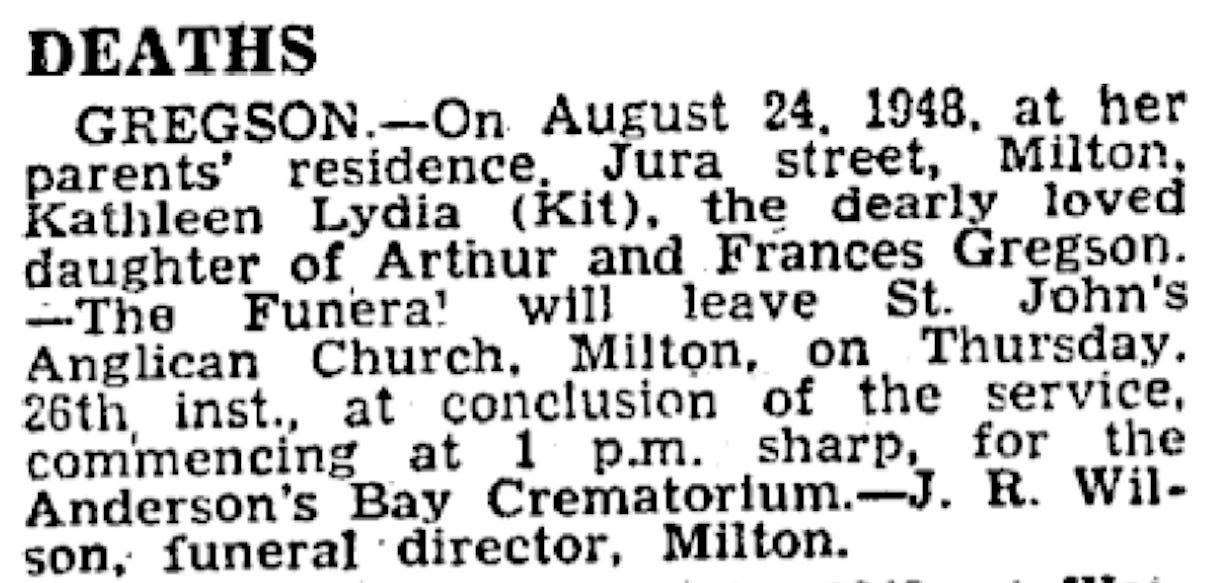
Kathleen Lydia Gregson died in August 1948 at the age of thirty-five.
She had reportedly suffered throughout her life after contracting rheumatic fever as a child. Newspaper notices from the time describe her funeral at St John’s Anglican Church in Milton before cremation at Anderson’s Bay.
Only four years later, Frances Mary Gregson also died.
Cancer.
She was cremated in Milton in January 1952.
After decades of movement across continents, Frances ended her life on the far side of the world from the Herefordshire farm where her family story had once changed forever.
Arthur eventually remarried and, at last, seems to have found a measure of peace in later life. He remained in Milton for decades afterwards and lived long enough to see grandchildren born before his death in 1977 at the age of ninety-one.
Yet even as I traced the family forward through New Zealand records, another mystery quietly emerged.
Because the deeper I researched Kathleen Lydia Gregson, the stranger the records became.
No birth appeared in New Zealand.
None in Australia.
None in Scotland.
For a while, it seemed as though she had appeared in the family story from nowhere.
But hidden within an old London birth record was another name entirely.
Kathleen Lydia Wootton.
And with it came an entirely new mystery……
You can read the first part of this tragic story here:
THE SHOOTING AT LOWER HOUSE FARM Part 1 — What Happened at Lower House Farm
I spend a lot of time researching and sharing these family connections, so if this post helped you uncover part of your family story, you can support my ongoing research here:

If you’d like to follow more of my research and stories, you can explore more here:
Milton! Wow what a place to end up - the very definition of small town New Zealand! I love that he employed local Māori ❤️
Paul, you gently hold the stories during your research. It is powerful.. You know something is there but the whole story takes a very long time to unfold, with trauma at the center. There was so much tragedy with no resources to process.. such great work..