
The Chiddicks Observer Special Edition
A fifteen-year search for sealed adoption records becomes a powerful reminder that genealogy is not about records alone—it is about restoring people to their own stories.

At The Chiddicks Observer, we spend a great deal of time discussing records, archives, methodology, technology, and research techniques. These things matter. They are the tools of our craft.
But every so often a piece comes along that reminds us why we use those tools in the first place.
Genealogy is often misunderstood as the pursuit of names, dates, and pedigrees. Those elements are important, but they are not the destination. They are simply the means by which we reach something deeper: understanding the lives of those who came before us and ensuring they are not forgotten.
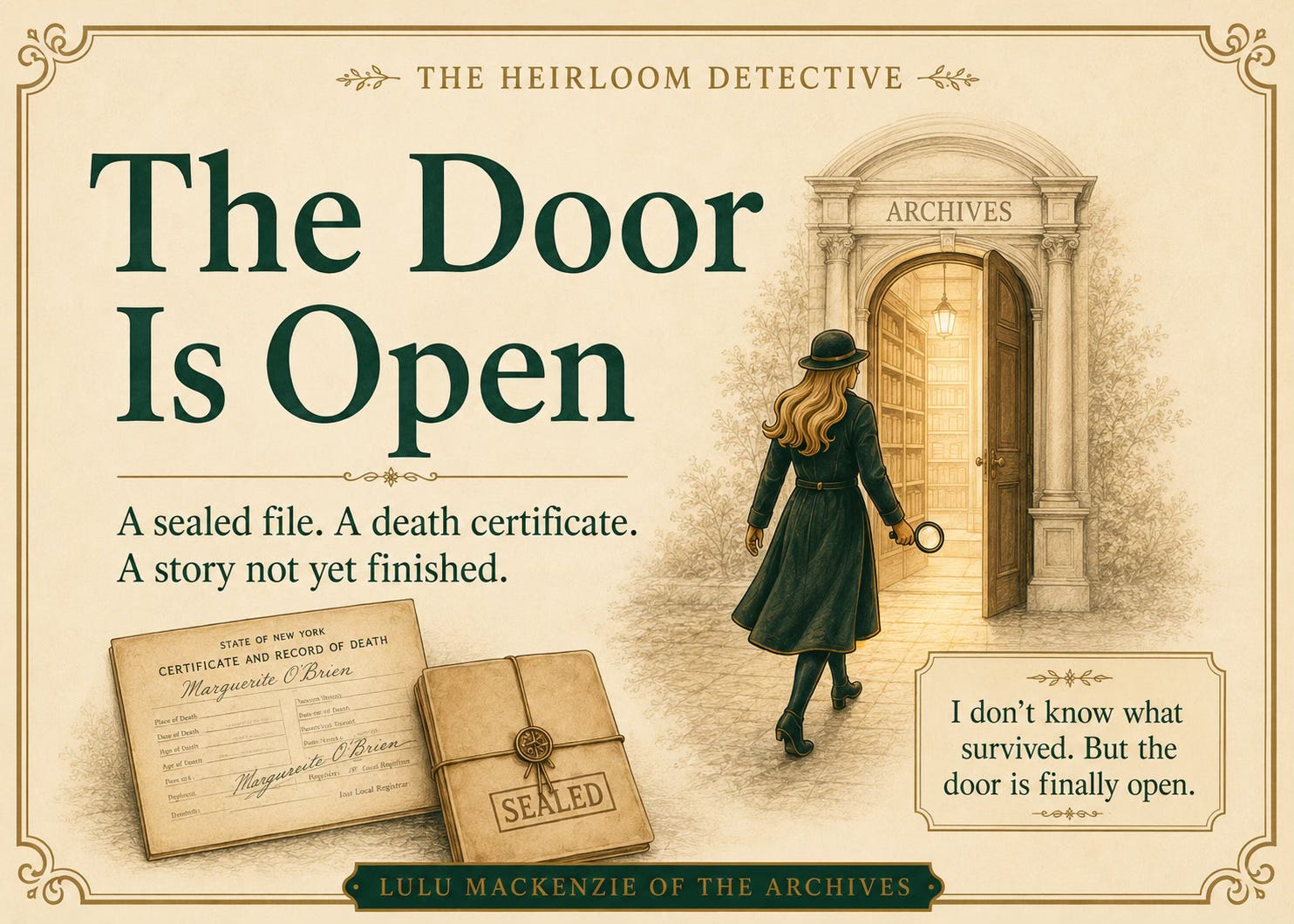
Lauren Maguire remarkable story, She Would Be 126 This Month. I Had to Prove She Was Dead, sits firmly in that space.

On one level, it is the story of a fifteen-year search for access to sealed records. Readers will recognise the familiar frustrations of archival research: institutional barriers, preservation restrictions, changing policies, missing documents, and the endless patience required to navigate them. Many family historians have experienced similar obstacles.
Yet this article is about far more than bureaucracy.
At its heart stands Marguerite O’Brien, a young woman whose story was effectively sealed away for more than a century. Not because she was famous, influential, or historically significant in any conventional sense, but because she was ordinary. She loved, suffered, hoped, made difficult choices, and left behind descendants who still sought to understand her.
What makes this story so powerful is that it asks a fundamental question: what do we owe the people whose stories remain unfinished?
The answer, at least in this case, was fifteen years of persistence.
As readers, we watch the Lauren pursue not simply a document, but a person. The death certificate becomes symbolic of something much larger: the determination to restore a missing chapter of a family’s history before the last living memories disappear forever.
Perhaps the most moving moment comes when the solution arrives not through official channels, but through family itself. A niece who loved and remembered her aunt preserved the very evidence needed to reopen the story. It is a beautiful reminder that while archives preserve records, families preserve memory.
That distinction matters.
At The Chiddicks Observer, we frequently celebrate remarkable discoveries, innovative research methods, and new genealogical resources. Yet the articles that stay with us longest are often those that reveal the humanity behind the research. The moments when an ancestor ceases to be a name in a database and becomes a real person once again.
By the end of this essay, Marguerite is no longer a line on a form or an entry in a ledger. She emerges as a daughter, a mother, an aunt, a woman remembered for her blue eyes, her kindness, her laughter, and the life she lived beyond the records.
That transformation is the highest purpose of genealogy.
This article is not simply one of the finest pieces of family history writing we have encountered this year. It is a reminder of what family history can achieve when research is guided by compassion, patience, and a commitment to remembrance.
In preserving Marguerite’s story, Lauren Maguire has also reminded us why we preserve any story at all.
I spend a lot of time researching and sharing these family connections, so if this post helped you uncover part of your family story, you can support my ongoing research here:

If you’d like to follow more of my research and stories, you can explore more here:
I loved this story. It’s what it’s all about, isn’t it? Why we are all compelled to do this.