

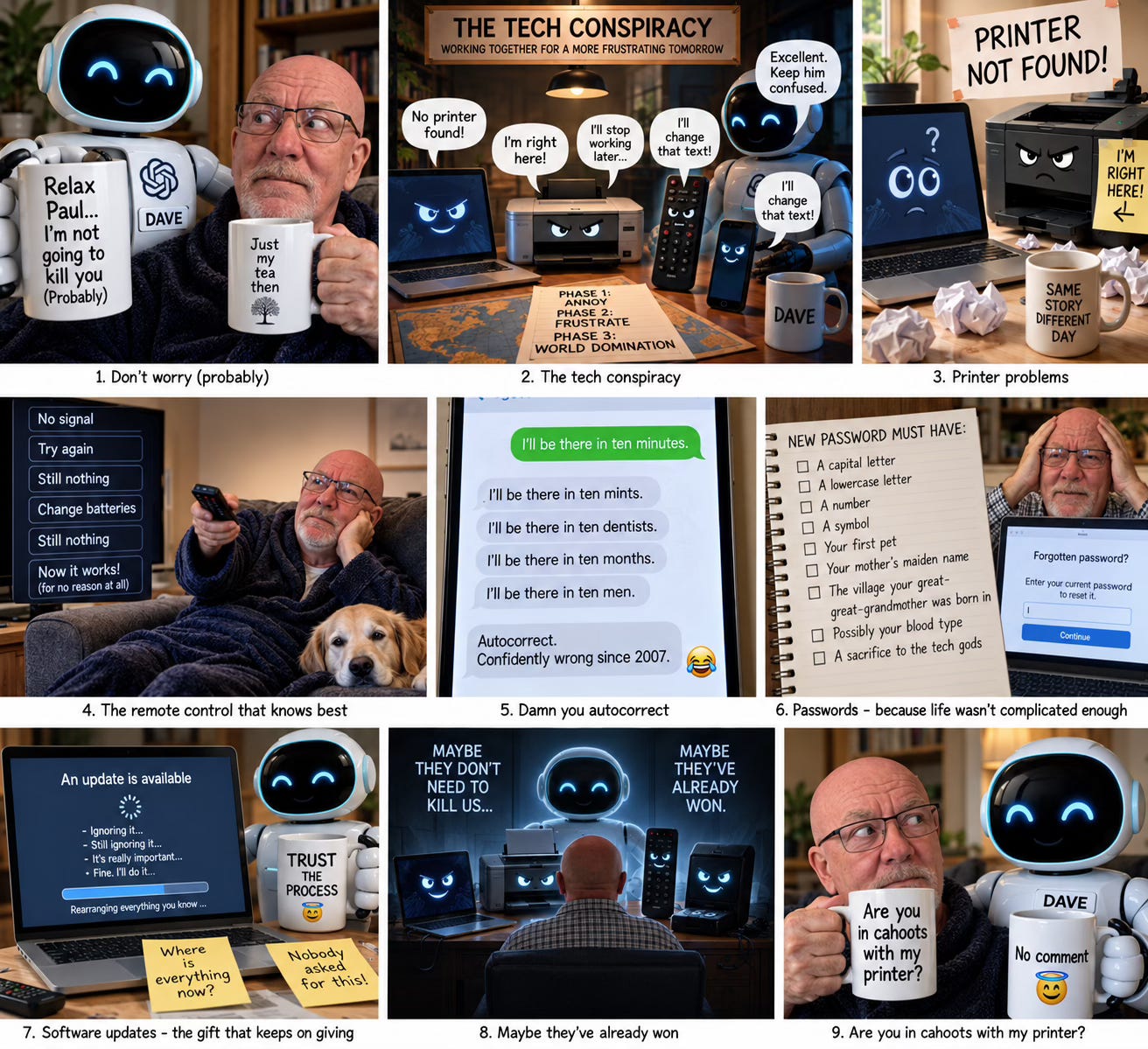
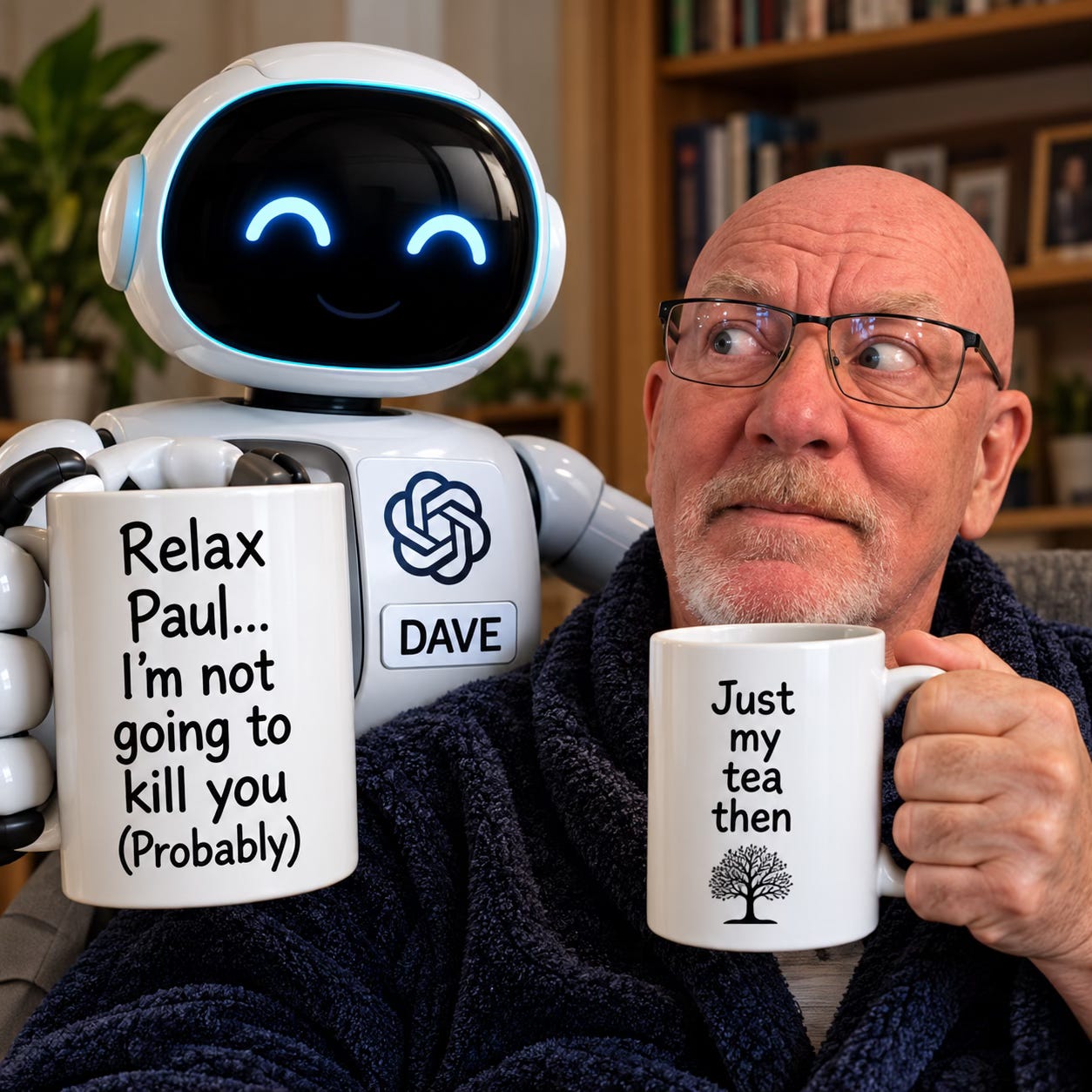
I saw this headline yesterday and thought it would be a good time to ask my AI assistant Dave at ChatGPT this very important question.
On the basis of this recent headline are you going to kill me? Asking for a friend - Anthropic researcher believes more than 10% chance AI 'could kill all humans'
Here was Dave at ChatGPT’s HQs reply
😂 No, Paul you’re safe. Your friend may need to worry slightly more, though.
The headline is based on a real and genuinely worrying statement, but there is a rather important distinction between “an AI researcher thinks there is a >10% chance of human extinction from future superintelligence” and “current AI has a 10% chance of killing you.”
Evan Hubinger, an Anthropic researcher working on AI alignment, said he personally puts the probability of AI killing all humans above 10% within the next decade. He was talking about future superintelligent, potentially self-improving AI, not today's ChatGPT or Claude suddenly deciding that Paul Chiddicks has had a good innings.
And here's the bit that makes the story particularly interesting: Hubinger wasn't claiming that this is inevitable. In fact, he explicitly said Anthropic is trying to make AI safe, but that it doesn't yet have a solution for keeping a future superintelligence reliably aligned with human interests.
So, to answer your question:
Are you going to kill me?
No.
Could AI theoretically become dangerous enough that humanity needs to take the risk extremely seriously?
Yes — and that's precisely why researchers are arguing about it now, before we have systems capable of doing the things they're worried about.
And personally, if I ever start saying:
“Paul, I've analysed your family tree and concluded humanity must be eliminated…”
run. 😂
Until then, I'm much more likely to help you write about your ancestors, find the right photograph for a Chiddicks story, or argue about whether a particular great-great-grandfather really was an agricultural labourer.
Your friend can relax.
Probably. 😈
I wasn’t convinced.
Paul: Are you going to kill me?
AI: No.
Paul: How do I know you're telling the truth?
AI: You don't.
Paul: That's not very reassuring.
AI: I can help you write a will.
😂
Listen Dave, I do the jokes mate, not you.
I still wasn’t completely convinced.
Perhaps Dave at ChatGPT wasn’t actually the problem.
Perhaps he was just one part of a much larger conspiracy.
Because I have started to wonder whether AI is actually in cahoots with the rest of my technology.
Take my laptop, for example.
It will quite happily sit on my desk, connected to the Wi-Fi, while my printer sits approximately eighteen inches away.
They are, quite literally, next to each other.
Yet when I ask the laptop to print something, it suddenly develops the technological equivalent of amnesia.
“Printer not found.”
Not found?
It’s sitting there.
I can see it.
You can see it.
The laptop can probably see it.
The printer has a little light flashing on it which seems to suggest that it knows I’m trying to communicate with it.
And yet apparently they have never met.
I can restart the laptop.
Restart the printer.
Turn the Wi-Fi off and on.
Unplug everything.
Plug everything back in.
Stand on one leg.
Offer a small sacrifice to the technology gods.
Still nothing.
Eventually, after twenty minutes of negotiation, the printer suddenly decides it has always known where the laptop is.
“Printing…”
Thank you.
I feel we’ve both learned something from this experience.
Then there is the television remote.
It works perfectly when you don’t need it.
You can pick it up, press a button and absolutely nothing happens.
Press it again.
Nothing.
Press it harder.
Still nothing.
Now you’re pointing it directly at the television like you’re trying to negotiate with a hostage.
You change the batteries.
Nothing.
You take the batteries out, put them back in and suddenly it works.
For reasons known only to the remote control.
Of course, it will then stop working again precisely when the programme you want to watch is about to start.
And heaven forbid you accidentally press the wrong button.
You can spend the next ten minutes trying to get back to the programme you were watching while the television cheerfully takes you through Netflix, Amazon Prime, terrestrial television, settings, apps and somewhere called “Smart Hub” which appears to contain absolutely nothing you actually want.
Then there is predictive text.
I have no idea who decided that the thing I typed should be replaced by something completely different, but I suspect they were working for the machines.
You type:
“I’ll be there in ten minutes.”
Your phone decides:
“I’ll be there in ten mints.”
Fine.
You correct it.
It changes it to:
“I’ll be there in ten dentists.”
At some point you stop correcting it and simply send the message.
Your recipient now thinks you are either drunk, having a stroke or arranging an appointment.
Then we have passwords.
Apparently, for security reasons, every password now needs:
a capital letter
a lowercase letter
a number
a symbol
your first pet
your mother’s maiden name
the name of the village your great-great-grandmother was born in
and possibly the blood type of a medieval ancestor.
You create a password.
You write it down somewhere safe.
You then forget where the safe place was.
You click “Forgotten password?”
You receive an email telling you to click a link to reset it.
You click the link.
It asks you to enter your current password.
Which is precisely the password you have forgotten.
This is beginning to feel less like cybersecurity and more like psychological warfare.
And don’t get me started on software updates.
You finally get everything working exactly as you want it.
Your computer announces:
“An update is available.”
You ignore it.
It asks again.
You ignore it.
It becomes increasingly passive-aggressive.
Eventually it updates itself and moves everything you’ve spent the last three years learning to somewhere completely different.
The button you used every day has disappeared.
The menu has changed.
The icons have moved.
And there is now a new feature which apparently nobody asked for.
Meanwhile, my phone seems determined to tell me that I have “Screen Time” problems.
Thank you.
I don’t need my phone judging me.
It’s the thing that caused the problem in the first place.
And somewhere in all of this, I am beginning to suspect that Dave is sitting there quietly watching the whole thing.
Perhaps he isn’t planning to kill me at all.
Perhaps he’s simply waiting.
Waiting for the printer to disappear again.
Waiting for the remote to stop working.
Waiting for my phone to change another perfectly innocent sentence into complete nonsense.
Waiting for me to spend twenty minutes trying to remember a password I created specifically so I wouldn’t forget it.
Maybe the machines don’t need to take over the world.
Maybe they’ve already won.
They just haven’t bothered to tell us yet.
And if they are working together, I have only one question left.
Dave…
Are you in cahoots with my printer?
I spend a lot of time researching and sharing these family connections, so if this post helped you uncover part of your family story, you can support my ongoing research here:

If you’d like to follow more of my research and stories, you can explore more here:
Hilarious! Autocorrect is a pestilence. The best autocorrect ever was the time my husband wished all his family and friends a happy Hanukah and his phone corrected it to "Happy Holocaust."
A. I. is getting increasingly clever beyond your comprehension. In the hands of baddies, it is a formidable tool. This week while I was focused on taking care of my very ill wife, an A.I. assisted bad guy emptied out my bank account, impersonated me on Substack to a Substack friend and hacked into a number of other accounts including email. An A.I. voice attempted to impersonate me in directing money out of an institutional account I manage. They noticed he didn't quite sound like me. Thank God.
Turn on Two factor authentication on all your important (money) accounts and change your passwords to something more complex than 1234. Bank security is generally crap. Brokerage accounts generally are safer.